
Single-Ended (SE) 50EH5 Tube Amplifier
Gio Militano  
|
Page 2: Construction, Sound
Background - SE 50EH5 Tube Amp
After completing a S-5 Electronics K-12M Tube Amplifier Kit, I became hooked on tubes. This page documents the design and construction of a small and simple Single Ended (SE) Tube Amplifier. The main goals for this project were to use as few parts as possible and to keep costs down.
This little amp is based around the small 50EH5 power pentode and is similar to other "spud" and flea power tube amps that I have stumbled across. Primarily, Dave's 5-Buck Amp and Dad's 50EH5 Single Ended Amplifier.
The 50EH5 is a miniature power pentode which was primarily designed and widely used in the audio power output stage of radio and television receivers and in phonographs. The tube features high power sensitivity at low plate and screen voltages. Tube characteristics and the typical operation for a Class A1 Amplifier is summarized below.
|
Plate Voltage Screen Voltage Cathode-Bias Resistor Peak Grid Voltage Plate Resistance Transconductance Zero-Signal Plate Current Maximum Signal Plate Current Zero Signal Screen Current Maximum Screen Current Load Resistance Total Harmonic Distortion (THD) Maximum-Signal Power Output |
110 Volts 115 Volts 62 Ohms 3.0 Volts 11000 Ohms 14600 Micromhos 42 Milliamperes 42 Milliamperes 11.5 Milliamperes 14.5 Milliamperes 2500 - 3000 Ohms 7 Percent 1.4 Watts |
To keep costs down on this project, the majority of the parts used have been salvaged from an old Fleetwood Stereo console that was purchased from a local thrift store for $7CDN. Photograph 01 shows the salvaged console and a map of the circuitry from the console is shown in Figure 1 below.

Photograph 1: Salvaged Fleetwood Stereo Console

Figure 1: Schematic of Fleetwood Tube Stereo Console
Single-Ended (SE) Tube Amplifier Design
The 50EH5 pentode has been widely used in many audio applications in past, so there is no need to develop a new design around this tube. On that basis, I decided to stick to the single ended amp design shown in the typical application notes.

Figure 2: 50EH5 Single-Ended (SE) Typical Operation Schematic
While the 50EH5 Single-Ended Typical Operation Schematic shows an output transformer with a load resistance of 3K, the 50EH5 Datasheet indicates that a load resistance of 2.5 to 3K is suitable for single ended operation.

Figure 3: 50EH5 Tube Power Supply Schematic
Figure 3 shows the schematic I used for the power supply. Obviously there are several improvements that can be made, but this supply has been designed around parts I had salvaged and had on hand. The caps used for filtering were salvaged from a dead computer monitor and do not need to be this big (470uF total should be enough). The transformer I used was salvaged from the Fleetwood tube console. I used PSU Designer II to model the power supply and it got me very close to final design that I eventually settled on. I was aiming for 50V on the heaters and ended up with 52V. Trying to stick to the application note, I was shooting for 110V on the plate and 115V on the screen. I ended up with 110.5V on the plate and 115.5V on the screen.
The final single ended amp design that I settled on is shown Figure 4 below. I used a 100k pot because that is what I had on hand.
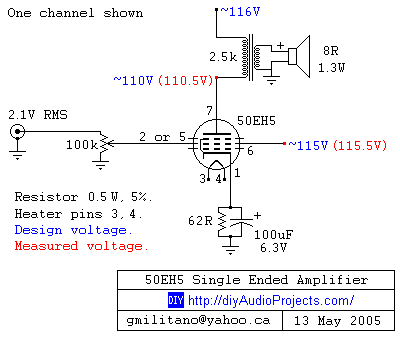
Figure 4: 50EH5 Single Ended Tube Amplifier Schematic
If you are looking for 50EH5 tubes, you can find them Tube Depot who has NOS 50EH5 vacuum tubes for $6 (Feb 2009).
| [ 1 | 2 ] |
Construction, Sound |