
Nanoo - DIY LM3875 Gainclone (IC / Chip Amplifier)
Mark Houston  
|
Gainclones
A while back, Gio introduced me to the concept of chip amplifiers (gainclones). That is, a single integrated circuit based on an operational amplifier (op amp) on a single substrate of silicon. The LM3875 is the "weapon of choice". This great chip, is a little larger than the size of a thumbnail and can deliver up to 56W RMS continuous with 100W peaks and it can do this at 0.05% distortion! Because they are DC amplifiers (DC coupling right through the amp) they can go all the way to 400kHz!
If that is not enough, you only need three resistors and a couple of reasonable line caps (1500uF will do) to build a high end amplifier. Small, powerful and flexible but most of all, when properly implemented, very musical and very natural.
The first chipamp I built was a pair of monoblocks. Though these are a little industrial looking, they deliver big time.

Photograph 01: LM3875 Monoblock Amplifiers
The Nanoo a DIY LM3875 IC Non-Inverting Chip Amplifier (Gainclone)
I was fascinated by the Patek - which is also based on the LM3875 op-amp chip. It is small, very elegant and with an external power supply.
I hate working in tight spaces but I am pretty good at it. Everything about this amplifier build was difficult due to the space restrictions. With many nights of pre-design trials I finally brought it all together.

Photograph 02: Nanoo Amplifier
A look at the images reveals just how small this amp is. The box size is 119 X 94 X 34 mm. It sits in the palm of your hand and has two volume attenuators, oversize solid brass isolation feet with pads, gold plated heavy duty speaker terminals, gold plated input jacks, pure silver (99.99%) wiring on the signal path, 5600uF filtering capacitors and heavy duty copper wiring to the speaker terminals. The schematic for The Nanoo is shown below in Figure 01.
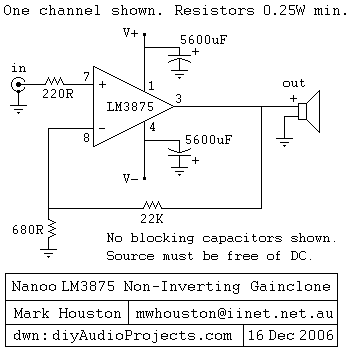
Figure 01: Schematic - LM3875 Non-Inverting Gainclone Amplifier
All wiring is similar to thispoint-to-point LM3875 gainclone using a breadboard. The chips are bolted to the sides of the case so cooling is not optimal. The amplifier is fitted with an RSR232 plug to receive power from the remote supply. The umbilical cord is heavy duty with two of the four wires supplying earth. A ferrite choke on the end of the power cord is used to reduce any stray EMI from going into the amp. The amplifier can be sat on the die cast case of the PS which sits on thick silicon feet.

Photograph 03: Nanoo Amplifier on Breadboard
External Power Supply
Power is supplied via an external power supply. An EMI filter is used to clean up the AC and the enclosure is a heavy Aluminum Die cast case. The power supply transformer is toriodal (160VA) and a high current bridge rectifier produces +/-35V. Two 4.7uF polyester capacitors are used to pre-filter the supply rails.

Figure 02: Power Supply Schematic for Nanoo

Photograph 04: External Power Supply for Nanoo

Photograph 05: Nanoo with External Power Supply
LM3875 Gainclone Sound
Good strong and clean sound. Not in the same class as the LM3875 monoblock amplifiers but extremely listenable. I use it as my family room amp driving two 63L 12" woofer based 3-way system. It drives these speakers easily and loud if required. I have tested my monoblock amplifiers to 400kHz and there is no reason why The Nanoo should not have the same frequency range.
More Chip Amp / Gainclone Amplifier Projects
- Gobo LM1875 Amplifier Kit
- DIY TDA2050 IC Hi-Fi Chip Amplifier
- Synergy - a LM3875 Gainclone Amplifier
- DIY LM3875 Chip Amplifier (Gainclone) Kit
- DIY LM3886 Chip Amplifier (Gainclone) Kit